The short answer
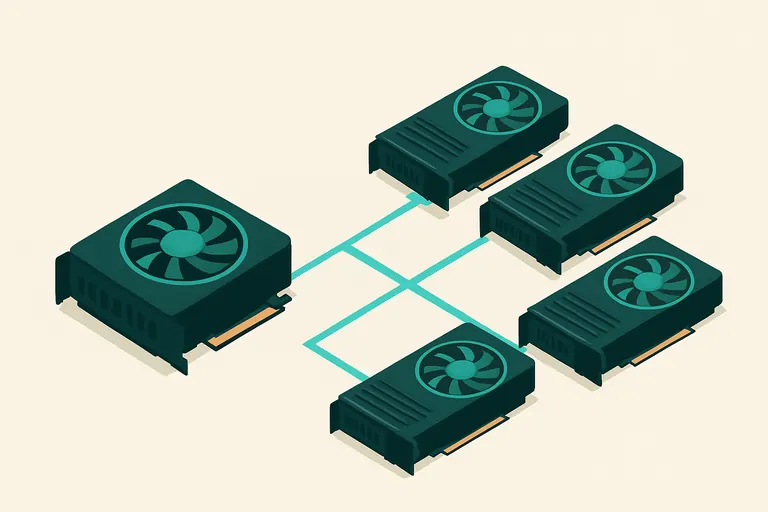
Inside one 8-GPU server, GPUs talk over NVLink or PCIe, and the network card is idle for collectives. The choice between InfiniBand and Ethernet only starts to matter when one job spans two or more servers. Then every gradient all-reduce, parameter all-gather or tensor-parallel exchange that crosses servers goes over the cluster network.
What matters most is not the brand of fabric but whether the network supports RDMA, so the NIC reads and writes GPU memory directly without the CPU copying data. InfiniBand does this natively. Ethernet does it with RoCE v2. A cluster that only offers ordinary TCP sockets between nodes will run, but the vLLM documentation states that socket transport is not efficient for cross-node tensor parallelism.
References: InfiniBand Trade Association: About InfiniBand · NVIDIA DOCA: RDMA over Converged Ethernet · vLLM documentation: Parallelism and scaling
InfiniBand vs Ethernet for AI, side by side
The table compares the two fabrics as NVIDIA, the InfiniBand Trade Association and the Ultra Ethernet Consortium describe them, read on 24 November 2026. Link speeds are per port. Vendor performance claims are quoted as claims.
| Item | InfiniBand | Ethernet with RoCE v2 |
|---|---|---|
| RDMA | Native | RDMA over UDP/IP (RoCE v2) |
| Current port speeds | NDR 400 Gb/s; XDR 800 Gb/s (Quantum-X800) | 400GbE common; 800G on Spectrum-X switches |
| Lossless behaviour | Built into the fabric | Needs flow control, such as PFC on every hop |
| In-network reduction | SHARP (v4 on Quantum-X800) | Not part of RoCE v2 |
| Routing | InfiniBand subnet with a subnet manager | Standard IP routing, UDP port 4791 |
| NIC example | ConnectX-7 at NDR 400 Gb/s | Same ConnectX-7 card at 400GbE |
| AI-tuned variant | Quantum-2 and Quantum-X800 platforms | NVIDIA Spectrum-X; Ultra Ethernet 1.x |
| Next step on roadmap | GDR 1.6 Tb/s planned for about 2028 (IBTA) | UEC 1.1 published October 2026 |
References: InfiniBand Trade Association: About InfiniBand · NVIDIA Quantum-X800 InfiniBand platform · NVIDIA ConnectX-7 adapter cards user manual: introduction · NVIDIA ConnectX-8 SuperNIC user manual: introduction · NVIDIA DOCA: RDMA over Converged Ethernet · NVIDIA Spectrum-X Ethernet platform · Linux Foundation: UEC launches Specification 1.0 · Ultra Ethernet Consortium specification versions · linux-rdma perftest README
InfiniBand: the purpose-built option
InfiniBand was designed for RDMA and high-performance computing. The InfiniBand Trade Association says NDR 400 Gb/s products are shipping and plans GDR at 1.6 Tb/s for about 2028. NVIDIA’s Quantum-X800 platform offers switches with 144 ports of 800 Gb/s and SHARP v4, which performs collective reductions inside the switches so less data crosses the network.
Flow control is part of the InfiniBand fabric itself, rather than something each switch must be configured for, and NVIDIA lists adaptive routing and congestion control among its quality-of-service features. The costs are a separate switching estate, a subnet manager that must run on a switch or node before traffic flows, and staff who know how to run it. In return you get a fabric built for one job.
References: InfiniBand Trade Association: About InfiniBand · NVIDIA Quantum-X800 InfiniBand platform · NVIDIA InfiniBand networking products · linux-rdma perftest README
Ethernet: RoCE v2, Spectrum-X and Ultra Ethernet
RoCE puts InfiniBand-style RDMA on Ethernet. NVIDIA’s documentation describes RoCE v1 as a Layer 2 protocol limited to one broadcast domain, and RoCE v2 as encapsulating RDMA in UDP/IP so it can cross IP routers, on UDP port 4791. The same page says RoCE requires flow control and recommends Priority Flow Control, enabled on every endpoint and switch in the path. Many cards are dual-protocol: NVIDIA lists the ConnectX-7 at NDR 400 Gb/s InfiniBand and 400GbE, and the ConnectX-8 at XDR InfiniBand and up to 400GbE.
Spectrum-X is NVIDIA’s Ethernet platform for AI. It pairs Spectrum switches with SuperNICs such as BlueField-3, ConnectX-8 and ConnectX-9, and adds adaptive routing and telemetry-based congestion control. NVIDIA claims 1.6x AI network performance over off-the-shelf Ethernet; the page does not state the test conditions.
The Ultra Ethernet Consortium published its 1.0 specification on 11 June 2025, built on standard Ethernet and covering transport, congestion control, NICs, switches and scale to very large endpoint counts. Its specification page lists version 1.1, dated 12 October 2026, as current. Check whether a provider’s hardware actually implements it before you rely on it.
References: NVIDIA DOCA: RDMA over Converged Ethernet · NVIDIA ConnectX-7 adapter cards user manual: introduction · NVIDIA ConnectX-8 SuperNIC user manual: introduction · NVIDIA Spectrum-X Ethernet platform · Linux Foundation: UEC launches Specification 1.0 · Ultra Ethernet Consortium specification versions
What it means for a rented GPU workload
For single-node work, the fabric is close to irrelevant. One 8-GPU server handles most fine-tuning, LoRA runs and inference up to the largest models that fit in its memory; single GPU vs multi-GPU covers that boundary, and NVLink vs PCIe covers the links inside the box.
For multi-node training, ask about the network before the GPU count. NVIDIA lists 0.8 TB/s of networking per HGX B200 board and 1.6 TB/s per HGX B300 board, and that bandwidth is only useful to a training job when the NICs carry RDMA and GPUDirect RDMA is enabled. GPUDirect RDMA gives a direct path for data between the GPU and a peer device such as a network card over PCIe.
For multi-node inference, vLLM recommends tensor parallelism within a node and pipeline parallelism across nodes, and notes that efficient cross-node tensor parallelism needs high-speed adapters such as InfiniBand. Choose InfiniBand when you want a known-good, tightly controlled training fabric. Choose a well-tuned RoCE or Spectrum-X network when the operator runs it at scale and can show NCCL numbers. In both cases, the measured bandwidth decides.
References: NVIDIA HGX platform specifications · NVIDIA GPUDirect RDMA documentation · vLLM documentation: Parallelism and scaling
When to pick InfiniBand and when to pick Ethernet
Use this as a first pass, then confirm with the test in the next section.
| Situation | Pick | Why |
|---|---|---|
| Job fits on one 8-GPU node | Either | Collectives stay on NVLink |
| Multi-node pretraining, tens of nodes | InfiniBand, or tuned Spectrum-X | Steady all-reduce bandwidth, SHARP on InfiniBand |
| 2 to 4 nodes of fine-tuning | RDMA on either fabric | RoCE v2 is fine if PFC and GIDs are right |
| Cross-node tensor-parallel inference | InfiniBand or RoCE with GPUDirect | vLLM flags sockets as inefficient |
| Independent inference replicas | Ordinary Ethernet | Replicas do not exchange tensors |
| Provider offers only TCP between nodes | Stay single-node | NCCL falls back to sockets |
References: vLLM documentation: Parallelism and scaling · NVIDIA DOCA: RDMA over Converged Ethernet · NVIDIA Quantum-X800 InfiniBand platform
A test you can run across two rented nodes
Start with the raw link. The perftest suite runs on both fabrics: start ib_write_bw -d mlx5_0 on one node and ib_write_bw -d mlx5_0 <server-ip> on the other. Add --use_cuda=0 on both sides, with a CUDA-enabled build, to test GPU memory through GPUDirect. The same options must be passed to client and server.
Then test NCCL. Run all_reduce_perf from nccl-tests across both nodes with NCCL_DEBUG=INFO, and set NCCL_IB_HCA to the right adapters, plus NCCL_IB_GID_INDEX on RoCE if the default does not select a working GID. The vLLM docs explain how to read the result: a transport such as NET/IB/GDRDMA means RDMA with GPUDirect, while NET/Socket means NCCL fell back to TCP, which NVIDIA’s NCCL docs say happens when IB or RoCE is unavailable or disabled.
Compare the busbw column with the per-GPU network speed you were quoted. If it is far below, or the log shows sockets, raise it with the operator before a long run. The planned guide to NCCL timeout errors covers the failure side.
References: linux-rdma perftest README · NVIDIA nccl-tests README · NVIDIA NCCL environment variables · vLLM documentation: Parallelism and scaling
Checklist and next step
Confirm whether the job needs more than one node. Ask which fabric, which NIC, how many NICs per GPU and whether GPUDirect RDMA is on. On Ethernet, ask whether RoCE v2 runs with PFC end to end. Run ib_write_bw and all_reduce_perf on day one. Check NCCL logs for NET/IB rather than NET/Socket. Compare cost per completed training run, not per GPU-hour; the evaluate a GPU operator checklist covers the rest.
To size a multi-GPU or multi-node configuration, request it on rent GPUs, or start from an H100 node. You receive a confirmed quotation, typically within one business day, with nothing charged until you approve. If you are unsure whether you need more than one node, ask the compute advisor.
NeuraMesh prices for these GPUs
| GPU | Memory | Data center | Value |
|---|---|---|---|
| RTX 4090 | 24 GB | $0.46 | $0.40 |
| L40S | 48 GB | $1.26 | $0.54 |
| A100 | 80 GB | $1.56 | $0.98 |
| H100 | 80 GB | $2.88 | $2.00 |
Every order is confirmed in a quotation before you pay. See all GPU prices.
Questions readers ask
Is InfiniBand better than Ethernet for AI?
For large multi-node training, InfiniBand is the most proven choice because flow control is built into the fabric and it offers in-network reduction with SHARP. Ethernet with RoCE v2, especially on AI-tuned platforms such as Spectrum-X, can reach the same 400 to 800 Gb/s link speeds. Measure NCCL bandwidth on the actual cluster.
What is RoCE v2?
RDMA over Converged Ethernet version 2 carries RDMA traffic inside UDP/IP packets on port 4791, so it can be routed across IP networks. Version 1 was limited to one Ethernet broadcast domain. RoCE needs flow control, usually Priority Flow Control on every switch and endpoint.
Does InfiniBand vs Ethernet for AI matter for inference?
Rarely. Most inference runs on one server, or as independent replicas that never exchange tensors. It matters only when one model is split across servers with tensor or pipeline parallelism, where vLLM recommends high-speed adapters and warns that TCP sockets are inefficient.
What is Ultra Ethernet?
An Ethernet-based specification for AI and HPC from the Ultra Ethernet Consortium. Version 1.0 was published on 11 June 2025 and version 1.1 on 12 October 2026. It covers transport, congestion control, NICs, switches and very large scale.
How do I know if NCCL is using InfiniBand or RoCE?
Set NCCL_DEBUG=INFO and read the log lines for each channel. NET/IB means the RDMA transport, used for both InfiniBand and RoCE, and GDRDMA means GPUDirect RDMA is active. NET/Socket means NCCL fell back to TCP.
Sources and editorial notes
- InfiniBand Trade Association: About InfiniBand
- NVIDIA DOCA: RDMA over Converged Ethernet
- vLLM documentation: Parallelism and scaling
- NVIDIA Quantum-X800 InfiniBand platform
- NVIDIA ConnectX-7 adapter cards user manual: introduction
- NVIDIA ConnectX-8 SuperNIC user manual: introduction
- NVIDIA Spectrum-X Ethernet platform
- Linux Foundation: UEC launches Specification 1.0
- Ultra Ethernet Consortium specification versions
- linux-rdma perftest README
- NVIDIA InfiniBand networking products
- NVIDIA HGX platform specifications
- NVIDIA GPUDirect RDMA documentation
- NVIDIA nccl-tests README
- NVIDIA NCCL environment variables
Primary documentation reviewed November 24, 2026. Provider descriptions reflect published documentation. Recommendations are our analysis; worked figures are illustrative unless explicitly stated otherwise. No independent provider benchmark or uptime ranking is claimed.
Need this GPU? Rent it from NeuraMesh: choose a GPU and plan, get a confirmed quotation, and pay only when you approve. See pricing.