Mixture of experts defined
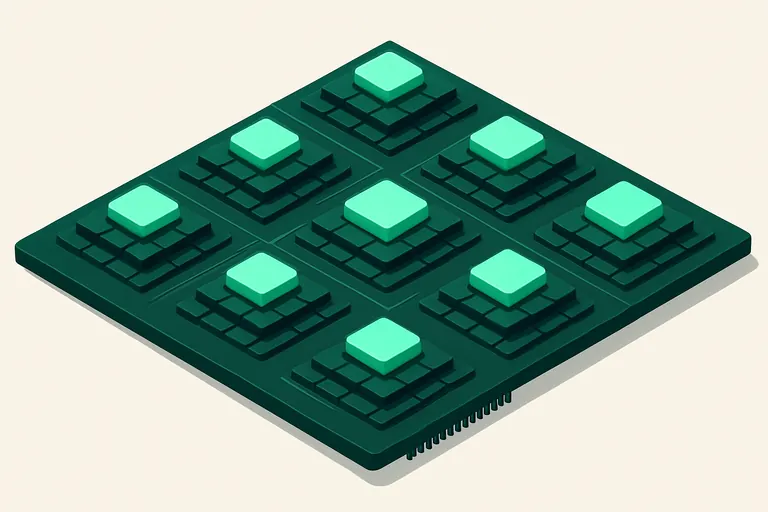
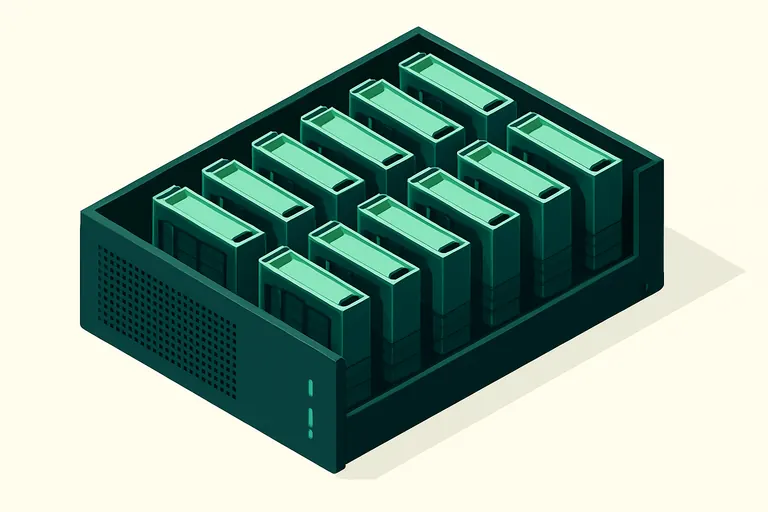
In a dense transformer, every token passes through every weight in every layer. An MoE layer swaps the single feed-forward block for a set of parallel feed-forward blocks, the experts, plus a small gating network, the router. For each token the router scores the experts and picks the top few. Only those run; the rest sit idle for that token.
The idea predates modern LLMs. Shazeer and colleagues’ 2017 paper introduced a sparsely gated MoE layer with up to thousands of feed-forward sub-networks and reported capacity increases of more than 1000x with only minor losses in computational efficiency. The term for this is conditional computation: how much of the model runs depends on the input.
Today many open models use the design. Mistral states that Mixtral picks two of eight experts at every layer for each token. DeepSeek-V3 has 671B total parameters with 37B activated for each token, and OpenAI’s gpt-oss-120b has about 117B parameters with 5.1B active.
References: Outrageously Large Neural Networks: The Sparsely-Gated Mixture-of-Experts Layer (arXiv) · Mistral AI: Mixtral of experts announcement · DeepSeek-V3 model card on Hugging Face · OpenAI gpt-oss-120b model card on Hugging Face
How routing works: a worked example
Take one MoE layer with 8 experts and top-2 routing, as in Mixtral. A token arrives as a vector. The router multiplies it by a small weight matrix to get 8 scores, keeps the 2 highest, and turns them into weights that sum to 1, say 0.7 and 0.3. The token runs through those two experts, and the layer output is 0.7 times the first expert’s output plus 0.3 times the second.
The next token may pick a different pair. Across a batch, every expert gets some tokens, but not evenly. Training adds a load-balancing objective so that no expert is flooded while others starve, and some systems cap how many tokens each expert accepts per batch.
The arithmetic is the attraction. Mixtral stores 46.7B parameters but uses only 12.9B per token, so it costs roughly what a 13B dense model costs per token to run, while carrying far more learned capacity.
References: Mistral AI: Mixtral of experts announcement
Total vs active parameters: memory vs compute
This is the point most buyers miss. The router can pick any expert for the next token, so every expert must already sit in GPU memory. Memory follows total parameters; compute and memory traffic per token follow active parameters.
The table gives weight memory from total parameters at the stated precision (2 bytes per parameter for BF16, 1 for FP8). It excludes KV cache and activations. gpt-oss-120b ships with its MoE weights in MXFP4, which is why its model card says it runs on a single 80 GB GPU.
| Model | Total params | Active per token | Approx. weight memory | Typical GPU fit |
|---|---|---|---|---|
| Mixtral 8x7B | 46.7B | 12.9B | ~93 GB in BF16 | 2 x 80 GB, or 1 x 141 GB |
| gpt-oss-20b | 21B | 3.6B | Runs within 16 GB (model card) | One card with 16 GB or more |
| gpt-oss-120b | 117B | 5.1B | Fits one 80 GB GPU (MXFP4 MoE weights) | 1 x 80 GB H100 |
| DeepSeek-V3 | 671B | 37B | ~671 GB in FP8 | 8 x 141 GB H200, not 8 x 80 GB |
References: Mistral AI: Mixtral of experts announcement · DeepSeek-V3 model card on Hugging Face · OpenAI gpt-oss-120b model card on Hugging Face
Expert parallelism and framework support
When experts do not fit on one GPU, expert parallelism places different experts on different GPUs. Each token is sent to the GPUs that hold its chosen experts and the results come back, an all-to-all exchange in every MoE layer. Attention layers are usually handled with tensor or data parallelism alongside.
In vLLM you add --enable-expert-parallel. The expert-parallel group size is computed as tensor-parallel size times data-parallel size, so TP=2 with DP=4 spreads experts across 8 GPUs. Without the flag, MoE layers use tensor parallelism instead. vLLM’s docs say EP is more efficient with data parallelism and offer several all-to-all backends, including DeepEP options for multi-node prefill and decode.
Megatron Core sets the degree with --expert-model-parallel-size together with --num-experts, recommends --moe-grouped-gemm, and requires sequence parallelism when expert and tensor parallelism are combined. See tensor parallelism for how those layers split.
| Framework | Setting | Note |
|---|---|---|
| vLLM | --enable-expert-parallel | EP size = TP x DP; pick an all-to-all backend |
| Megatron Core | --expert-model-parallel-size, --num-experts | Needs sequence parallelism with TP |
References: vLLM expert parallel deployment documentation · Megatron Core parallelism strategies guide
Costs and trade-offs on rented GPUs
You pay for memory by the hour, so an MoE model costs like its total size to host and like its active size to compute. That suits high-traffic serving, where many requests share the loaded weights, and suits it less for a single user who needs all that memory for light traffic.
Illustrative example with assumed numbers: hosting a model like DeepSeek-V3 in FP8 needs an 8-GPU node with 141 GB cards. At an assumed $3 per GPU-hour, that is $24 an hour whether it serves one request or thousands. A dense 8B model on one GPU at an assumed $2 is $2 an hour. Compare on cost per million tokens at your real load. Our planned guides to DeepSeek V3 GPU requirements and gpt-oss GPU requirements size specific models.
Quantization helps MoE models a lot because memory is the binding limit. Expert parallelism across nodes, by contrast, needs fast networking because of the all-to-all in every layer.
References: DeepSeek-V3 model card on Hugging Face · vLLM expert parallel deployment documentation
Common misconceptions
A 671B MoE model only needs memory for 37B. False: every expert must be resident, because any token can route to any expert.
Each expert learns a human topic such as code or math. Routing is learned per token and per layer, and expert specialization is rarely that clean.
MoE is always cheaper. It is cheaper per token of compute at a given quality, but it needs more memory, and small batches may not keep the many experts busy.
References: Mistral AI: Mixtral of experts announcement
Related terms
Active parameters are the weights used per token; total parameters are all stored weights. The router, or gate, picks experts. Expert parallelism spreads experts across GPUs. FP4 formats such as MXFP4 shrink expert weights. Data parallelism is often paired with expert parallelism in serving.
Checklist and next step
Size GPU memory from total parameters, not active ones. Add KV cache headroom. Prefer one NVLink node before spreading experts across nodes. Enable expert parallelism with data parallelism for high-throughput serving. Measure cost per million tokens at your real concurrency.
NeuraMesh rents high-memory nodes by the hour: see H200 rental or choose a GPU, plan, count, hours and region on rent GPUs, and you receive a confirmed quotation before paying. The compute advisor can check whether a model fits.
NeuraMesh prices for these GPUs
| GPU | Memory | Data center | Value |
|---|---|---|---|
| RTX 4090 | 24 GB | $0.46 | $0.40 |
| L40S | 48 GB | $1.26 | $0.54 |
| A100 | 80 GB | $1.56 | $0.98 |
| H100 | 80 GB | $2.88 | $2.00 |
Every order is confirmed in a quotation before you pay. See all GPU prices.
Questions readers ask
What is mixture of experts in simple terms?
A model built from many expert sub-networks plus a router. For each token the router picks a few experts to run, so the model can be very large while each token uses only a fraction of it.
What are active parameters?
The parameters actually used to process one token. Mixtral uses 12.9B of its 46.7B per token; DeepSeek-V3 uses 37B of 671B. Compute per token follows active parameters.
How much GPU memory does an MoE model need?
Enough for all of its weights at your chosen precision, plus KV cache. Use total parameters times bytes per parameter as the starting point, not the active count.
What is expert parallelism?
Placing different experts on different GPUs and sending each token to the GPUs holding its chosen experts. In vLLM it is enabled with --enable-expert-parallel.
Are MoE models faster than dense models?
Per token, an MoE model computes like a much smaller dense model, so it can generate faster at the same quality. But it needs more memory and enough batch to keep experts busy.
Sources and editorial notes
- Outrageously Large Neural Networks: The Sparsely-Gated Mixture-of-Experts Layer (arXiv)
- Mistral AI: Mixtral of experts announcement
- DeepSeek-V3 model card on Hugging Face
- OpenAI gpt-oss-120b model card on Hugging Face
- vLLM expert parallel deployment documentation
- Megatron Core parallelism strategies guide
Primary documentation reviewed November 24, 2026. Provider descriptions reflect published documentation. Recommendations are our analysis; worked figures are illustrative unless explicitly stated otherwise. No independent provider benchmark or uptime ranking is claimed.
Need this GPU? Rent it from NeuraMesh: choose a GPU and plan, get a confirmed quotation, and pay only when you approve. See pricing.