LoRA vs full fine-tuning at a glance
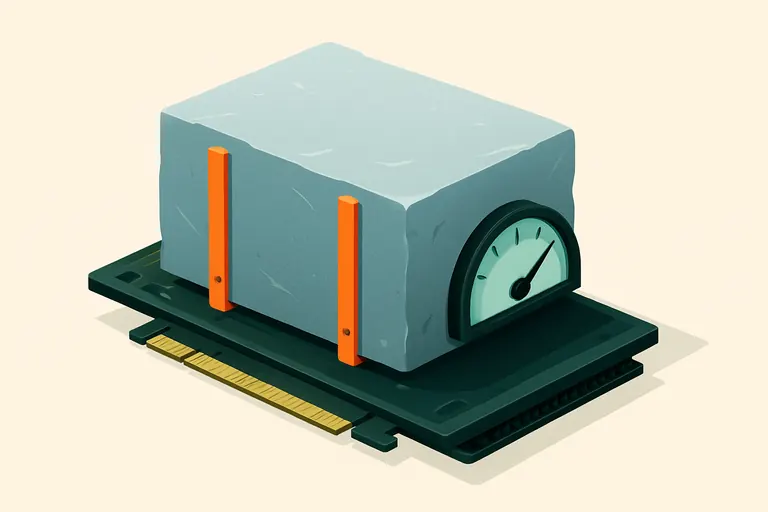
Full fine-tuning updates every weight in the model. LoRA, from Hu et al. (2021), freezes the pretrained weights and learns a low-rank update: two small matrices, A and B, whose product is added to selected weight matrices. Only A and B train, so gradients and optimizer state exist only for them.
The table summarizes the practical differences. Hugging Face PEFT is the most common LoRA library; its latest release on GitHub was v0.22.0 (19 November 2026). For the cost side of a LoRA experiment, see LoRA fine-tuning cost.
| Item | LoRA | Full fine-tuning |
|---|---|---|
| What trains | Small adapter matrices on chosen layers | Every parameter |
| Model-state memory | Frozen base at 2 bytes per parameter (BF16) plus small adapter | About 16 bytes per parameter with mixed-precision Adam |
| Typical GPUs for an 8B model | One 24 to 80 GB GPU | Several GPUs with sharding |
| Output | Adapter of megabytes to a few GB | Full copy of the model |
| Inference cost | None extra after merging | None extra |
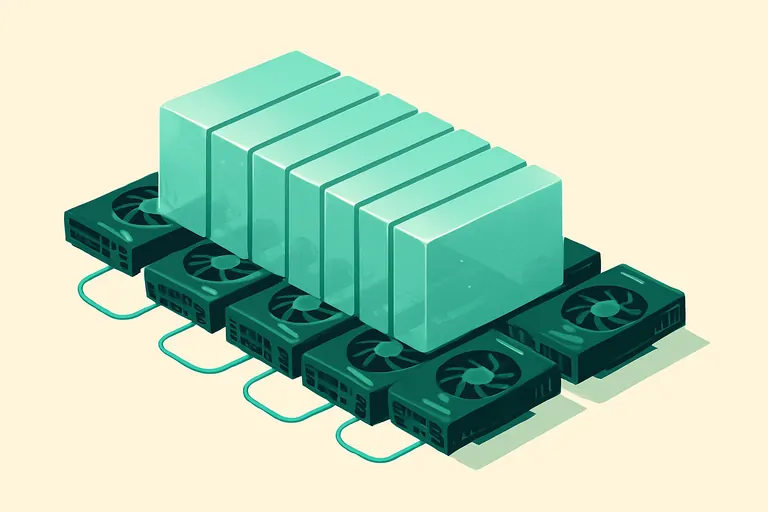
| Many task variants | One base, many adapters | One full model per task |
| Capacity to learn new knowledge | Limited by rank and target layers | Highest |
| Forgetting of base skills | Less, per published work | More |
References: Hu et al., LoRA: Low-Rank Adaptation of Large Language Models · Hugging Face PEFT: LoRA · Hugging Face PEFT GitHub repository and releases · Hugging Face PEFT LoRA developer guide
The memory math
Start with the figure from the ZeRO paper: mixed-precision Adam needs 16 bytes per trainable parameter for model states, made of 2 bytes of 16-bit weights, 2 bytes of gradients and 12 bytes for the FP32 weight copy, momentum and variance. Activations come on top and grow with batch size and sequence length.
LoRA changes the count of trainable parameters, not the size of the base. The frozen base still sits in GPU memory at 2 bytes per parameter in BF16, or about half a byte at 4-bit as in QLoRA. The adapter adds r times (d + k) parameters for each d by k matrix it wraps. For a 4,096 by 4,096 projection at rank 16, that is 131,072 trainable parameters against 16.8 million in the full matrix, under 1%.
The table shows model states only, as an illustrative calculation. Real runs need more for activations, the CUDA context and fragmentation, so leave headroom. Our VRAM calculator and LLM VRAM budget guide add those terms.
| Model size (illustrative) | Full fine-tuning, 16 B/param | LoRA, BF16 base | QLoRA, 4-bit base |
|---|---|---|---|
| 8B | 128 GB | About 16 GB plus adapter | About 4 to 5 GB plus adapter |
| 14B | 224 GB | About 28 GB plus adapter | About 7 to 8 GB plus adapter |
| 70B | 1,120 GB | About 140 GB plus adapter | About 35 to 40 GB plus adapter |
References: Rajbhandari et al., ZeRO: Memory optimizations toward training trillion parameter models · Hu et al., LoRA: Low-Rank Adaptation of Large Language Models · Dettmers et al., QLoRA: Efficient finetuning of quantized LLMs
What published papers found on quality
The evidence points two ways, and the difference is mostly dataset size and domain. The original LoRA paper reported quality on par with or better than full fine-tuning on RoBERTa, DeBERTa, GPT-2 and GPT-3, with 10,000 times fewer trainable parameters and 3 times less GPU memory than fine-tuning GPT-3 175B with Adam. QLoRA reported fine-tuning a 65B model on a single 48 GB GPU while preserving full 16-bit fine-tuning task performance.
Biderman et al. (TMLR, 2024), in LoRA Learns Less and Forgets Less, found that in standard low-rank settings LoRA substantially underperforms full fine-tuning for code and math, in both continued pretraining and instruction tuning. LoRA did better at keeping the base model’s skills outside the target domain. They found full fine-tuning learns weight changes with 10 to 100 times higher rank than typical LoRA settings.
Thinking Machines’ LoRA Without Regret (September 2025) reported that LoRA matched full fine-tuning on small-to-medium instruction and reasoning datasets and in reinforcement learning, even at rank 1 for RL, when applied to all layers including the MLP layers. It fell behind when the dataset exceeded the adapter’s capacity and at large batch sizes, and the best LoRA learning rate was about 10 times the full fine-tuning rate. These are the authors’ results on their setups; yours depend on model, data and settings.
| Source and date | Finding as published | Setting |
|---|---|---|
| Hu et al., LoRA, 2021 | On par or better than full fine-tuning | RoBERTa, DeBERTa, GPT-2, GPT-3 |
| Dettmers et al., QLoRA, 2023 | 65B on one 48 GB GPU, 16-bit task performance kept | 4-bit NF4 base, LoRA adapters |
| Biderman et al., TMLR 2024 | LoRA substantially underperforms; forgets less | Code and math, low rank |
| Thinking Machines, Sep 2025 | Matches full fine-tuning on small-to-medium data and RL | All layers incl. MLP, tuned learning rate |
References: Hu et al., LoRA: Low-Rank Adaptation of Large Language Models · Dettmers et al., QLoRA: Efficient finetuning of quantized LLMs · Biderman et al., LoRA Learns Less and Forgets Less (TMLR 2024) · Thinking Machines: LoRA Without Regret (Sep 2025)
Settings that close the gap
Target all linear layers, not just attention. PEFT’s default adds LoRA to the query and value layers only. Its docs recommend target_modules="all-linear", as QLoRA did, and the Thinking Machines results found attention-only LoRA underperformed even with matched parameter counts.
Raise the learning rate relative to full fine-tuning, and raise the rank when the dataset is large or far from the base model’s training data. Keep batch sizes moderate. If quality still falls short at a high rank on a large dataset, that is the signal full fine-tuning may be worth its cost. PEFT also offers variants such as DoRA, which its docs say can help especially at low ranks, at extra overhead.
References: Hugging Face PEFT LoRA developer guide · Thinking Machines: LoRA Without Regret (Sep 2025) · Biderman et al., LoRA Learns Less and Forgets Less (TMLR 2024)
How each behaves on a rented GPU
LoRA on a 7B to 14B model fits one GPU. A 24 GB card such as an RTX 4090 handles QLoRA on that range; a 48 GB L40S or an 80 GB H100 handles BF16 LoRA with room for longer sequences. Checkpoints are small, so saving often costs little, and you can serve many adapters on one base: vLLM lists multi-LoRA serving. After training, PEFT’s merge_and_unload folds the adapter into the base weights, removing any extra inference latency.
Full fine-tuning an 8B model needs 128 GB for model states before activations, so plan on a multi-GPU node with sharding. FSDP or DeepSpeed ZeRO-3 divides that across GPUs; FSDP vs DeepSpeed compares the two. Checkpoints are full model copies plus optimizer state, so they are large and slow to write; budget storage and save time. A full fine-tune of a 70B model is a multi-node job.
References: Hugging Face PEFT LoRA developer guide · Rajbhandari et al., ZeRO: Memory optimizations toward training trillion parameter models · vLLM GitHub repository · Dettmers et al., QLoRA: Efficient finetuning of quantized LLMs
When to pick LoRA or full fine-tuning
Settle LoRA vs full fine-tuning with evidence, not habit. Start with LoRA. Move to full fine-tuning when a well-tuned LoRA run, at high rank on all layers, still misses your quality bar.
| Your situation | Pick | Reason |
|---|---|---|
| Instruction or style tuning, small-to-medium dataset | LoRA | Published results show parity at this scale |
| Many customers or tasks on one base model | LoRA | Swap small adapters; serve many at once |
| One GPU budget | LoRA or QLoRA | Base frozen, low optimizer memory |
| Reinforcement learning on a pretrained model | LoRA | Matched full fine-tuning even at low rank in one study |
| Continued pretraining on a large new domain | Full fine-tuning | Higher capacity; LoRA lagged on code and math |
| Base skills must stay intact | LoRA | Forgets less outside the target domain |
References: Biderman et al., LoRA Learns Less and Forgets Less (TMLR 2024) · Thinking Machines: LoRA Without Regret (Sep 2025) · Hu et al., LoRA: Low-Rank Adaptation of Large Language Models
A test you can run yourself
Hold out an evaluation set that reflects your task, plus a general benchmark to catch forgetting. Train LoRA on all linear layers at two ranks, such as 16 and 128, with a learning-rate sweep. If budget allows, run full fine-tuning on the same data for the same number of tokens. Compare task score, general score, wall-clock hours and GPU-hours. Our guides to fine-tune an LLM with LoRA and QLoRA fine-tuning cover the setup.
References: Hugging Face PEFT LoRA developer guide
Checklist and next step
Estimate model states: 16 bytes per parameter for full fine-tuning, about 2 for a BF16 LoRA base, about half for QLoRA. Target all linear layers. Tune the learning rate for LoRA separately. Measure forgetting, not only task score. Merge adapters before serving if you need one model. Move to full fine-tuning only when evidence says LoRA has hit its ceiling.
NeuraMesh rents single GPUs for LoRA runs and multi-GPU nodes for full fine-tuning, by the hour. Choose GPU, plan, count, hours and region on rent GPUs, and you receive a confirmed quotation, typically within one business day, with nothing charged until you approve.
NeuraMesh prices for these GPUs
| GPU | Memory | Data center | Value |
|---|---|---|---|
| RTX 4090 | 24 GB | $0.46 | $0.40 |
| L40S | 48 GB | $1.26 | $0.54 |
| A100 | 80 GB | $1.56 | $0.98 |
| H100 | 80 GB | $2.88 | $2.00 |
Every order is confirmed in a quotation before you pay. See all GPU prices.
Questions readers ask
Is LoRA as good as full fine-tuning?
Often, for instruction and style tuning on small-to-medium datasets, when LoRA covers all linear layers and the learning rate is tuned. Biderman et al. (2024) found it substantially behind on large code and math training in standard low-rank settings. Evaluate on your own task.
How much less memory does LoRA use?
Full fine-tuning with mixed-precision Adam needs about 16 bytes per parameter for model states. LoRA keeps the frozen base at about 2 bytes per parameter in BF16, plus a small adapter. The original paper reported 3 times less GPU memory for GPT-3 175B.
When should I choose full fine-tuning over LoRA?
When you are teaching a lot of new knowledge, such as continued pretraining on a large domain corpus, and a high-rank LoRA on all layers still misses your target. Budget for multi-GPU sharding and large checkpoints.
Does LoRA slow down inference?
Not after merging. The LoRA paper reports no additional inference latency, because the low-rank update can be merged into the base weights. PEFT provides merge_and_unload for this. Unmerged adapters served alongside a base model add some overhead.
What LoRA rank should I use?
Start with a moderate rank such as 16 on all linear layers, then test a higher rank. Raise it for larger datasets or harder domains. Published work suggests rank matters less than covering all layers and tuning the learning rate.
Sources and editorial notes
- Hu et al., LoRA: Low-Rank Adaptation of Large Language Models
- Hugging Face PEFT: LoRA
- Hugging Face PEFT GitHub repository and releases
- Hugging Face PEFT LoRA developer guide
- Rajbhandari et al., ZeRO: Memory optimizations toward training trillion parameter models
- Dettmers et al., QLoRA: Efficient finetuning of quantized LLMs
- Biderman et al., LoRA Learns Less and Forgets Less (TMLR 2024)
- Thinking Machines: LoRA Without Regret (Sep 2025)
- vLLM GitHub repository
Primary documentation reviewed November 24, 2026. Provider descriptions reflect published documentation. Recommendations are our analysis; worked figures are illustrative unless explicitly stated otherwise. No independent provider benchmark or uptime ranking is claimed.
Need this GPU? Rent it from NeuraMesh: choose a GPU and plan, get a confirmed quotation, and pay only when you approve. See pricing.