LLM API vs self-hosting: the short decision
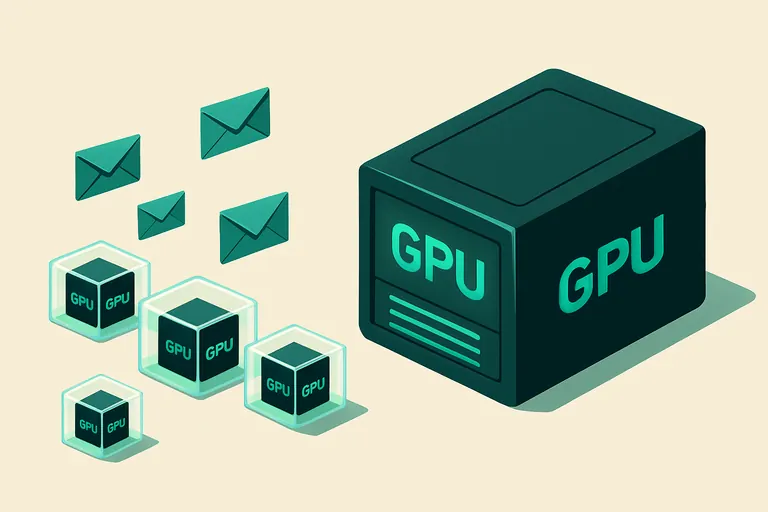
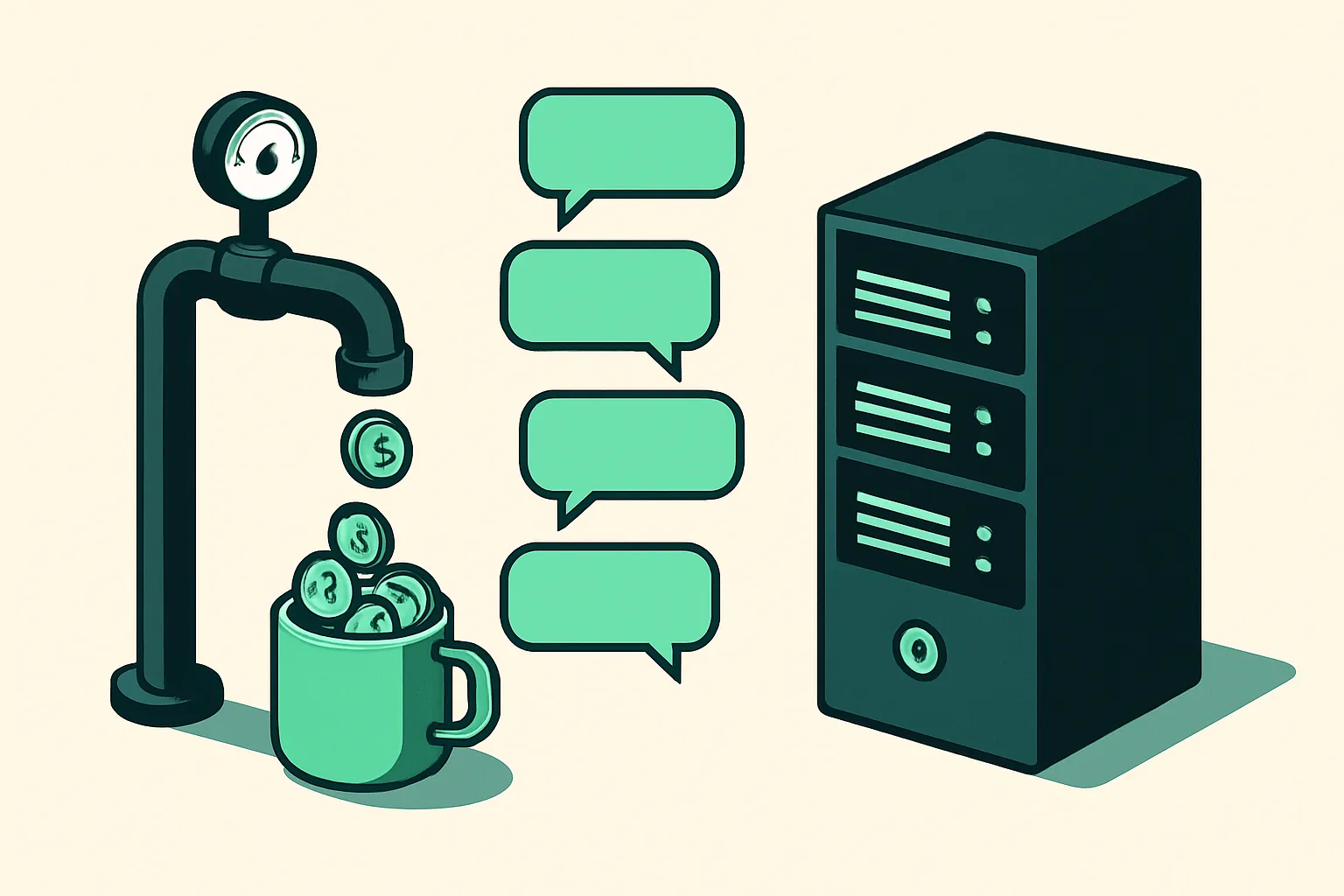
An API charges for what you use: tokens in and tokens out. Self-hosting charges for what you reserve: GPU-hours, whether those GPUs are busy or idle. The cheaper option is whichever matches your traffic shape and the model you need.
If your volume is low or unpredictable, per-token pricing is hard to beat because you pay nothing between requests. If your volume is high and steady, a dedicated GPU running an open-source LLM near full use can cost far less per token. Everything else in this comparison refines that rule.
| Factor | Pay-per-token API | Self-hosted on dedicated GPUs |
|---|---|---|
| Traffic shape | Spiky, low or unknown volume | Steady, high daytime or 24-hour load |
| Model | Proprietary frontier models | Open-weight or your own fine-tuned model |
| Cost driver | Tokens processed | GPU-hours reserved, busy or idle |
| Data path | Requests go to the provider | Requests stay on infrastructure you control |
| Latency | Shared capacity and provider limits | Tunable, but you size for peaks |
| Operations | Provider runs the stack | You run serving, scaling and monitoring |
When a pay-per-token API wins
Choose an API when traffic is spiky or small. A support bot that handles a few thousand conversations a day would leave a dedicated GPU idle most of the time, and you would pay for every idle hour. With per-token pricing, quiet periods cost nothing.
An API is also the only route to proprietary frontier models, since their weights are not available to run yourself. If your product depends on a specific closed model’s quality, the comparison ends there for that part of the workload.
Finally, an API removes operations work. Someone has to patch the serving stack, watch GPU memory, handle failed workers and plan capacity for a self-hosted endpoint. If your team has no one to own that, the hidden staffing cost can outweigh any saving on tokens.
When self-hosting an open-source LLM wins
Self-hosting wins when demand is steady enough to keep GPUs busy. Dedicated GPU inference turns a variable per-token bill into a fixed hourly cost, and the more tokens each GPU serves, the lower your cost per token falls. High, predictable volume is the classic case.
Data control is the second reason. Some teams cannot send prompts containing customer records or source code to a third party, or must keep processing in a specific region. Running an open-weight model on GPUs you rent in a chosen region keeps the request path under your control.
Latency and customization are the third. You can pin a model revision, tune batch size and context limits, and serve your own fine-tuned weights; see the LoRA fine-tuning budget for what training an adapter costs. For setup, our vLLM deployment guide covers serving an open model on a cloud GPU.
References: Hugging Face PEFT: LoRA
The break-even method: tokens per day against GPU-hours per day
The break-even point is where a day of API spending equals a day of GPU spending. API cost per day is tokens per day multiplied by the per-token price. Self-hosted LLM cost per day is GPU-hours per day multiplied by the hourly price, plus storage, monitoring and the engineering time to run it.
Rearranged, break-even tokens per day equal daily GPU cost divided by the price per token. That number only matters if your GPUs can actually serve it. So the second question is capacity: tokens per second per GPU, at your latency target and real concurrency, multiplied by 86,400 seconds.
Count the costs that do not appear on a GPU quote. Model storage, logging, a standby replica for failover and the hours an engineer spends on upgrades all belong in the daily figure. On the API side, count retries, prompt overhead such as long system messages, and any rate-limit workarounds you have to build.
Capacity is the number most break-even estimates get wrong. It depends on the model, precision, prompt and output lengths, the serving engine and how many requests arrive together. You have to measure it on the GPU you plan to rent rather than copy it from a chart.

An illustrative break-even example with real arithmetic
Every number here is illustrative, chosen for easy arithmetic, and none is a quote from any provider. Assume an API at $2.00 per million tokens and one dedicated GPU at $3.00 per hour, running 24 hours. The GPU costs $72 a day, so break-even is $72 ÷ $2.00 = 36 million tokens a day.
Now test the capacity. If you measure 1,500 tokens per second under realistic concurrency, one GPU can serve about 129.6 million tokens a day. Break-even sits at roughly 28% utilization, and at full use the GPU costs about $0.56 per million tokens. Self-hosting wins comfortably once steady volume passes 36 million tokens a day.
Repeat with a measured 400 tokens per second, perhaps because prompts are long or the model is larger. Capacity drops to about 34.6 million tokens a day and the cost at full use rises to about $2.08 per million. The GPU never beats the API price, whatever your volume. Same hardware, same hourly rate, opposite answer.
| Illustrative input | Scenario A | Scenario B |
|---|---|---|
| API price per million tokens | $2.00 | $2.00 |
| GPU price per hour × 24 hours | $3.00 × 24 = $72/day | $3.00 × 24 = $72/day |
| Break-even volume | 36M tokens/day | 36M tokens/day |
| Measured throughput per GPU | 1,500 tokens/s | 400 tokens/s |
| Daily capacity (× 86,400 s) | ≈129.6M tokens | ≈34.6M tokens |
| Cost per million at full use | ≈$0.56 | ≈$2.08 |
| Outcome | Self-hosting wins above 36M/day | API stays cheaper at any volume |
Test to run before you commit to dedicated GPUs
Rent the exact GPU for a few hours and load the model revision and precision you plan to serve. Replay a sample of real prompts with the same input and output length distribution. Raise concurrency in steps until time to first token or total latency breaks your target, and record successful tokens per second at that point.
vLLM ships a serving benchmark with request-rate and dataset controls, and NVIDIA documents memory reporting through nvidia-smi so you can see KV cache pressure as concurrency rises. Our LLM inference benchmark guide describes a reproducible run. Use that measured figure, minus headroom for peaks, as the capacity in your break-even.
Also price your traffic hour by hour. A load that is high for 10 hours and near zero overnight may need GPUs only during the day, or a hybrid. If utilization is the problem after launch, see low GPU utilization.
References: vLLM serving benchmark options · NVIDIA System Management Interface
The hybrid pattern: one steady model, one overflow path
Many teams do not choose one side. They run their steady, high-volume open-source LLM on dedicated GPUs sized for the normal daily load, and send proprietary-model requests and traffic spikes to an API. The GPUs stay busy, and the API absorbs the peaks you would otherwise overprovision for.
The cost is routing logic, two sets of limits and two failure modes to monitor. Use the hybrid when your measured baseline is large enough to keep at least one GPU well above break-even utilization. Our serverless vs dedicated GPU comparison applies the same reasoning to GPU workers.
NeuraMesh is building NM-API, coming soon, to put both paths behind one key: per-token access to models and dedicated GPU capacity for your steady workload. It is not live yet.
Choosing your path in the LLM API vs self-hosting decision
Start with an API if you are pre-launch, your traffic is unknown or you need a closed model. Collect token counts per hour for a few weeks. That data turns a guess into a break-even calculation.
Move the steady part to dedicated GPUs when measured volume sits well above break-even, or when data control and latency require it. With NeuraMesh you choose the GPU, a Data center plan for production or a Value plan for batch work, the GPU count, hours and region. You get a confirmed quotation, typically within one business day, and nothing is charged until you approve. Current rates are on GPU prices.
Checklist: measure tokens per day and their hourly shape; measure throughput per GPU at your latency target; compute break-even with storage and staff time included; confirm the model license allows your use; plan the overflow path before launch.
NeuraMesh prices for these GPUs
| GPU | Memory | Data center | Value |
|---|---|---|---|
| L40S | 48 GB | $1.26 | $0.54 |
| A100 | 80 GB | $1.56 | $0.98 |
| H100 | 80 GB | $2.88 | $2.00 |
| H200 | 141 GB | $4.60 | $2.73 |
Every order is confirmed in a quotation before you pay. See all GPU prices.
Questions readers ask
Is self-hosting an LLM cheaper than using an API?
Only above a break-even volume that depends on your GPU price, the API price and measured throughput per GPU. At low or spiky volume the API is usually cheaper because idle GPU-hours still cost money. At steady high volume a well-utilized dedicated GPU can cost much less per token.
How do I calculate self-hosted LLM cost per token?
Divide the hourly GPU price by the tokens one GPU serves per hour at your latency target, measured under real concurrency. Then scale by expected utilization, and add storage, monitoring and engineering time. Never use a peak tokens-per-second figure from a different model or prompt mix.
What is the break-even point for LLM API vs self-hosting?
It is the daily token volume where API spending equals GPU spending: daily GPU cost divided by price per token. It only holds if your measured GPU capacity exceeds that volume. If capacity is below it, the API stays cheaper regardless of how much traffic you have.
Can I self-host a proprietary model like the ones behind major APIs?
Generally no. Proprietary frontier models are offered through their providers and their weights are not released for you to run. Self-hosting applies to open-weight models and your own fine-tunes. Check each open model’s license for commercial use before deploying it.
Does self-hosting improve LLM latency?
It can, because you control batch size, context limits and region, and you are not sharing capacity with other customers. But you must size for peak traffic. An undersized dedicated endpoint queues requests and can be slower than an API during bursts.
Sources and editorial notes
Primary documentation reviewed November 18, 2026. Provider descriptions reflect published documentation. Recommendations are our analysis; worked figures are illustrative unless explicitly stated otherwise. No independent provider benchmark or uptime ranking is claimed.
Need this GPU? Rent it from NeuraMesh: choose a GPU and plan, get a confirmed quotation, and pay only when you approve. See pricing.