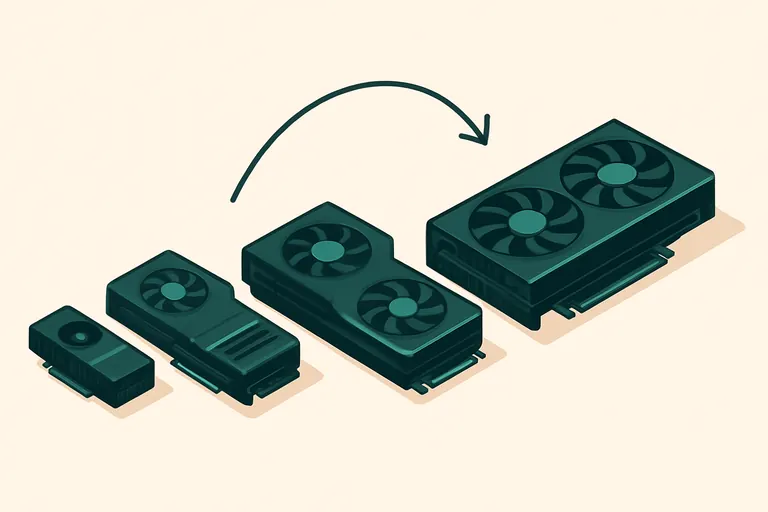
The Whisper models and their sizes
Whisper is OpenAI’s encoder-decoder speech recognition model. The README lists six sizes, from tiny at 39M parameters to large at 1,550M, with a required VRAM figure and a relative speed for each. Turbo, at 809M parameters, is an optimized large-v3 with fewer decoder layers. OpenAI measured the relative speeds by transcribing English speech on an A100 and warns real-world speed varies with language, speaking speed and hardware.
Whisper’s code and weights are released under the MIT license. Large-v3 changed the input to 128 Mel frequency bins from 80 and was trained on 1 million hours of weakly labeled audio and 4 million hours of pseudo-labeled audio. The model has a 30-second receptive field, so long recordings are processed in 30-second windows.
| Size | Parameters | Required VRAM (OpenAI) | Relative speed (A100) |
|---|---|---|---|
| tiny | 39M | ~1 GB | ~10x |
| base | 74M | ~1 GB | ~7x |
| small | 244M | ~2 GB | ~4x |
| medium | 769M | ~5 GB | ~2x |
| large (v1, v2, v3) | 1,550M | ~10 GB | 1x |
| turbo | 809M | ~6 GB | ~8x |
References: OpenAI Whisper GitHub README · openai/whisper-large-v3 model card
large-v3 and turbo architecture
Both large-v3 and large-v3-turbo have a 32-layer encoder with a model width of 1,280 and 20 attention heads, reading up to 1,500 encoder positions (30 seconds of audio) and generating up to 448 tokens per window. The difference is the decoder: large-v3 has 32 decoder layers, turbo has 4. The turbo card describes it as the exact same model as large-v3 except that the decoding layers were reduced from 32 to 4, then fine-tuned.
That matters for speed more than memory. The decoder runs once per output token, so cutting it from 32 layers to 4 removes most of the per-token work. Hugging Face lists 1.54B parameters for large-v3 and 0.81B for turbo. Distil-large-v3 goes further, with 2 decoder layers and 0.76B parameters, and is compatible with faster-whisper.
| Model | Parameters | Encoder layers | Decoder layers | License |
|---|---|---|---|---|
| whisper-large-v3 | 1.54B | 32 | 32 | MIT (code and weights) |
| whisper-large-v3-turbo | 0.81B | 32 | 4 | MIT |
| distil-large-v3 | 0.76B | 32 | 2 | MIT |
References: openai/whisper-large-v3 config.json · openai/whisper-large-v3-turbo model card · distil-whisper/distil-large-v3 model card · faster-whisper GitHub README
Whisper GPU requirements by precision
Weights are parameters × bytes. Large-v3 is 1.54B × 2 bytes ≈ 3.1 GB in FP16, about 1.5 GB in INT8 and 6.2 GB in FP32. Turbo is about 1.6 GB in FP16. The decoder cache adds, per sequence in FP16, 2 × layers × 1,280 × 2 bytes for each of up to 448 output tokens (about 73 MB for large-v3), plus a cross-attention cache over 1,500 encoder positions (about 246 MB). Turbo’s 4-layer decoder cuts both to about 40 MB in total. Beams and batch multiply this, though engines differ in how much they share.
Measured totals run higher than weights alone because of the framework, activations and cache. OpenAI’s ~10 GB and ~6 GB figures are for its reference PyTorch code. faster-whisper published lower figures for large-v2, which has the same parameter count as large-v3: 4,525 MB at FP16, 2,926 MB at INT8, and 6,090 MB at FP16 with batch size 8, all with beam size 5. The VRAM calculator covers the weight arithmetic.
| Setup | Weights (arithmetic) | Published total VRAM | Source |
|---|---|---|---|
| large, openai/whisper | ≈3.1 GB FP16 | ~10 GB | OpenAI README |
| turbo, openai/whisper | ≈1.6 GB FP16 | ~6 GB | OpenAI README |
| large-v2, faster-whisper FP16 | ≈3.1 GB | 4,525 MB | faster-whisper README |
| large-v2, faster-whisper INT8 | ≈1.5 GB | 2,926 MB | faster-whisper README |
| large-v2, faster-whisper FP16, batch 8 | ≈3.1 GB | 6,090 MB | faster-whisper README |
| large-v2, faster-whisper INT8, batch 8 | ≈1.5 GB | 4,500 MB | faster-whisper README |
References: OpenAI Whisper GitHub README · faster-whisper GitHub README · openai/whisper-large-v3 config.json · openai/whisper-large-v3-turbo model card
Published speed: real-time factor from benchmarks
faster-whisper’s README times 13 minutes of audio with large-v2 at beam size 5 on an RTX 3070 Ti 8 GB with CUDA 12.4. openai/whisper took 2 minutes 23 seconds at FP16. faster-whisper took 1 minute 3 seconds at FP16, 17 seconds at FP16 with batch size 8, and 16 seconds at INT8 with batch size 8.
Dividing 780 seconds of audio by those times gives about 5.5x real time for openai/whisper, 12x for faster-whisper unbatched and about 46x to 49x batched. Those ratios are our arithmetic on their published numbers for that one card and file; they are not a forecast for other GPUs. The large-v3 card separately reports that torch.compile gives a 4.5x speed-up for the Transformers forward pass, though not with the chunked algorithm or Flash Attention 2.
| Implementation (large-v2, RTX 3070 Ti) | Time for 13 min | Derived real-time factor |
|---|---|---|
| openai/whisper FP16 | 2m23s | ≈5.5x |
| faster-whisper FP16 | 1m03s | ≈12x |
| faster-whisper INT8 | 59s | ≈13x |
| faster-whisper FP16, batch 8 | 17s | ≈46x |
| faster-whisper INT8, batch 8 | 16s | ≈49x |
References: faster-whisper GitHub README · openai/whisper-large-v3 model card
Which GPU for Whisper
Memory is rarely the limit: every data-center card NeuraMesh rents, from the 16 GB T4 up, holds large-v3 with room for batching. Choose on throughput per dollar. A T4 or L4 suits steady, low-volume transcription. An RTX 4090, A10 or L40S gives more throughput for batch jobs. An A100 or H100 makes sense mainly when you run large batches or share the GPU with other models, such as an LLM that summarizes the transcripts.
GPU memory beyond about 8 GB mostly buys batch size, and batch size is where the published speed gains came from. The catch is that a fast GPU waiting on audio decoding or disk reads is wasted, which is the subject of low GPU utilization.
| Workload | Starting GPU | Why |
|---|---|---|
| Occasional files, turbo or large-v3 | T4 16 GB or L4 24 GB | Fits easily; low hourly cost |
| Real-time streaming, a few streams | L4 or RTX 4090 | Low latency per window |
| Bulk archive transcription | RTX 4090, A10 or L40S | Room for large batches |
| Whisper plus an LLM on one card | A100 or H100 80 GB | Memory for both models |
References: faster-whisper GitHub README · OpenAI Whisper GitHub README
Serve it: faster-whisper, Transformers or vLLM
faster-whisper: pip install faster-whisper, then WhisperModel("large-v3", device="cuda", compute_type="float16"), or compute_type="int8_float16" for INT8 on GPU. For batches, wrap it in BatchedInferencePipeline and call transcribe with batch_size=16; the README’s example uses turbo. GPU execution needs cuBLAS for CUDA 12 and cuDNN 9, and the nvidia/cuda:12.3.2-cudnn9-runtime-ubuntu22.04 image includes both. Unlike openai-whisper, it does not need a system FFmpeg.
Transformers: the large-v3 card shows a pipeline with chunk_length_s=30 and a batch_size for long files, and notes the sequential algorithm is more accurate for batches of long files. vLLM: vllm serve openai/whisper-large-v3 exposes an OpenAI-compatible /v1/audio/transcriptions endpoint. The vLLM deployment runbook covers drivers and Docker.
References: faster-whisper GitHub README · openai/whisper-large-v3 model card · vLLM example: speech-to-text with the OpenAI client
Illustrative cost per audio hour
Cost per audio hour is the GPU rate divided by your measured real-time factor. The table is illustrative: it assumes $0.40 per GPU-hour and shows three real-time factors as inputs, not measured results for any GPU. Measure your own factor on a sample of your audio with your chosen model, precision and batch size.
Billing counts allocated time, so idle hours between jobs cost the same as busy ones; GPU-hour cost explained covers the arithmetic. Current NeuraMesh rates are on GPU prices.
| Assumed real-time factor | GPU-hours per 1,000 audio hours | Cost at an assumed $0.40/hour |
|---|---|---|
| 10x | 100 | $40 |
| 40x | 25 | $10 |
| 100x | 10 | $4 |
Checklist and next step
Pick the model: turbo for speed, large-v3 for maximum accuracy, distil-large-v3 for English at lower cost. Use faster-whisper or vLLM rather than the reference code for production. Try INT8 and batching, measure real-time factor on your own audio, and keep the GPU fed by decoding audio in parallel.
NeuraMesh rents GPUs by the hour: choose a GPU, a plan, GPU count, hours and region on rent GPUs, and you receive a confirmed quotation, typically within one business day, with nothing charged until you approve. If you are unsure which card gives the best cost per audio hour, ask the compute advisor.
NeuraMesh prices for these GPUs
| GPU | Memory | Data center | Value |
|---|---|---|---|
| RTX 4090 | 24 GB | $0.46 | $0.40 |
| L40S | 48 GB | $1.26 | $0.54 |
| A100 | 80 GB | $1.56 | $0.98 |
| H100 | 80 GB | $2.88 | $2.00 |
Every order is confirmed in a quotation before you pay. See all GPU prices.
Questions readers ask
What are the minimum Whisper GPU requirements for large-v3?
OpenAI lists about 10 GB with its reference code. faster-whisper published 4.5 GB at FP16 and 2.9 GB at INT8 for large-v2, which has the same size as large-v3. An 8 GB card can run it with faster-whisper; 16 GB leaves room for batching.
How much VRAM does Whisper turbo need?
OpenAI lists about 6 GB for turbo with its reference implementation. The FP16 weights are about 1.6 GB, and its 4-layer decoder keeps the decoder cache small, so optimized engines use less.
Is Whisper turbo as accurate as large-v3?
Turbo is large-v3 with the decoder pruned from 32 layers to 4 and then fine-tuned, and OpenAI lists it at about 8x the speed of large. Accuracy varies by language, so test on your own audio before switching.
Can Whisper run in real time on a GPU?
Yes, comfortably. faster-whisper’s published benchmark transcribed 13 minutes of audio in about 1 minute on an 8 GB RTX 3070 Ti with large-v2, roughly 12x real time, and faster with batching.
Do I need an H100 for Whisper?
Rarely. Whisper fits on any 16 GB card. An H100 or A100 helps mostly when you run very large batches or share the GPU with other models. For most transcription, an L4, RTX 4090 or L40S gives better cost per audio hour.
Sources and editorial notes
- OpenAI Whisper GitHub README
- openai/whisper-large-v3 model card
- openai/whisper-large-v3 config.json
- openai/whisper-large-v3-turbo model card
- distil-whisper/distil-large-v3 model card
- faster-whisper GitHub README
- vLLM example: speech-to-text with the OpenAI client
Primary documentation reviewed November 24, 2026. Provider descriptions reflect published documentation. Recommendations are our analysis; worked figures are illustrative unless explicitly stated otherwise. No independent provider benchmark or uptime ranking is claimed.
Need this GPU? Rent it from NeuraMesh: choose a GPU and plan, get a confirmed quotation, and pay only when you approve. See pricing.